
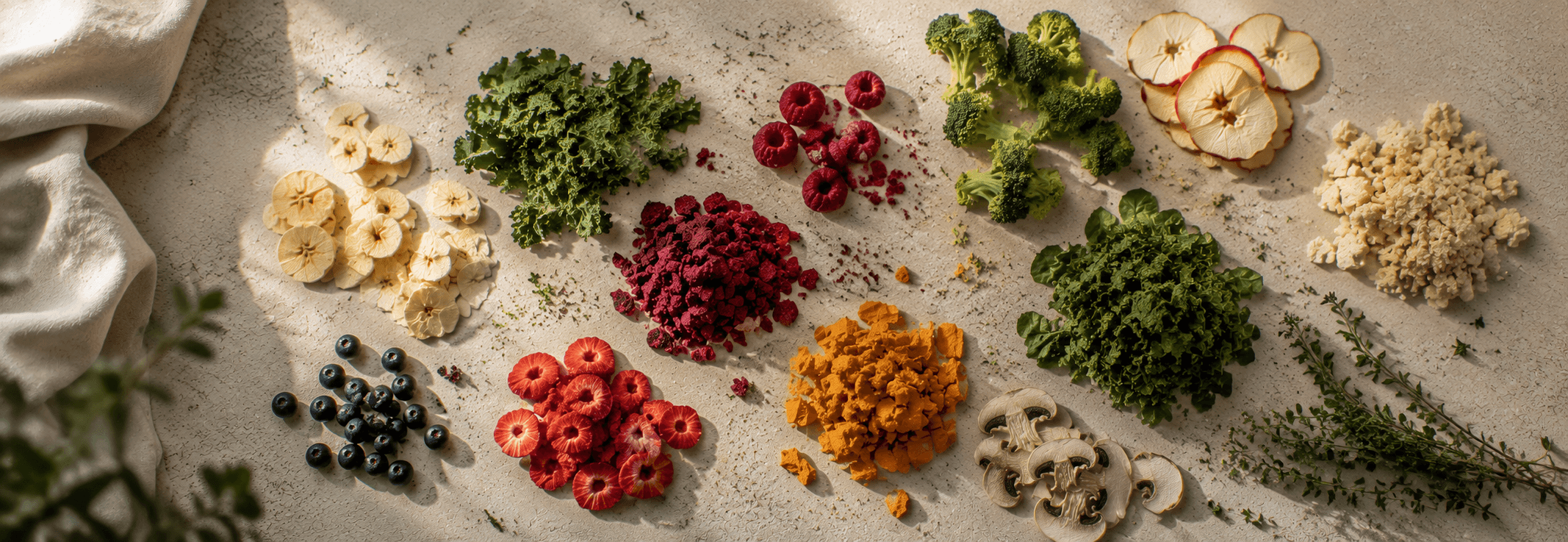
What makes Terranova products different from other supplement brands? One major difference is the fresh freeze-dried advantage.
Terranova has more than 150 products, all of which contain organic and phytonutrient-rich, fresh freeze-dried whole foods and botanicals.
So, what is fresh freeze drying exactly?
Freeze drying, scientifically known as lyophilization, is the process in which water is removed from a product after it is frozen and placed in a vacuum, which allows ice to convert directly from solid to gas without passing through the liquid phase.
Standard commercial methods for drying plants used in supplements include air, spray or oven drying. These commercial methods can degrade important compounds and alter a plant’s delicate and synergistic biochemical balance. However, research shows that freeze drying actually protects and retains much of a fresh plant’s potency, biochemical integrity and enzymatic activity. In fact, the biochemical profile of a fresh freeze-dried plant very closely resembles a concentrated version of the original fresh plant, due to the removal of the plant’s moisture content. Freeze-drying yields potent, shelf-stable food and botanical products with all the active components of fresh plants intact.
How does fresh freeze drying work?
The entire freeze-drying process takes 9-24 hours. It is a 3-stage process that consists of:
- Step 1: FREEZE. Freshly picked herbs, botanicals, fruits and vegetables are frozen at peak ripeness to ensure they retain all the living vitality of the fresh plant
- Step 2: VAPORIZE. The frozen foods and botanicals are then placed into a low-pressure vacuum chamber to be gently removed of water via sublimation
- Step 3: SEAL. The fresh freeze-dried foods and botanicals are sealed in moisture and oxygen-proof packaging to ensure freshness and maintenance of the original nutritional profiles. Shortly after, they are blended in Terranova formulas.

The history of fresh freeze drying
Freeze drying has a long history as a preservation technology. Early applications date back to the late 19th century, while its use expanded significantly during World War II, when freeze drying was used to help preserve blood plasma and other biological materials without conventional refrigeration.
Since then, freeze drying has become an important preservation method across a range of fields, including pharmaceuticals, biotechnology and food production. Its application to botanicals is particularly interesting. Unlike conventional drying methods, which can expose plants to heat for prolonged periods, freeze drying removes moisture at very low temperatures. This makes it possible to preserve much more of the biochemical character of the freshly harvested plant.
What is the fresh freeze-dried advantage?
- Fresh freeze drying retains virtually all of the original biochemical integrity of a fresh plant, including the enzymatic activity
- Fresh freeze drying prevents most enzymatic and chemical changes associated with other drying methods that can reduce activity and alter biochemical balance
- Fresh freeze drying typically allows plants to retain potency and shelf stability for longer than other drying methods. It can preserve a product for up to 25 years, remaining as fresh as the day it was dried
- Fresh freeze drying produces ingredients with a high solubility, which may facilitate assimilation of the plant’s nutrients and other important compounds within the digestive tract
- Fresh freeze drying produces highly porous and brittle plant material, which can be milled into powder (i.e. for encapsulation) without generating destructive levels of heat or friction
Fresh freeze drying at Terranova
From the beginning, fresh freeze-dried botanicals have been a defining part of the Terranova formulation philosophy. Terranova uses carefully selected fresh freeze-dried whole foods and botanicals across its product range, including herbs, fruits, vegetables and other plant ingredients. Wherever possible, plants are harvested at an appropriate stage of development and freeze dried while fresh, rather than first being subjected to conventional drying processes.
Why does this matter?
A botanical ingredient is much more than one isolated compound. A fresh plant naturally contains a complex combination of phytonutrients, enzymes and other naturally occurring compounds. The way the plant is processed after harvesting can significantly influence what remains in the finished ingredient. Fresh freeze drying is therefore not simply a method of preservation for Terranova. It is part of our approach to maintaining the plant in a form that remains as close as practically possible to its original fresh biochemical profile.
This philosophy is also central to MAGNIFOOD®, Terranova’s signature complexes combining nutrients with carefully selected whole foods and botanicals.
What is the fresh freeze-dried advantage?
Preservation of biochemical integrity
Fresh freeze drying helps retain the naturally occurring compounds of the fresh plant, including heat-sensitive constituents and enzymatic activity.
Minimal exposure to heat
Unlike many conventional drying processes, freeze drying takes place at very low temperatures, helping minimise heat-related degradation.
Concentration without conventional high-temperature drying
Once water is removed, the resulting freeze-dried material represents a naturally concentrated form of the original fresh plant.
Excellent stability
Removing moisture helps create a shelf-stable botanical ingredient while preserving much of the character of the freshly harvested plant.
Highly porous structure
Freeze drying produces a light, porous and brittle material that can be milled into powder without requiring the high levels of heat or friction associated with some other processing methods.
See the Difference!
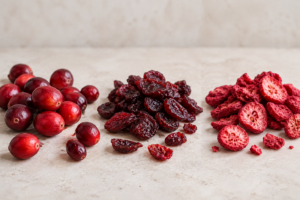
Fresh vs, Air-dried raspberries vs. Fresh & freeze-dried cranberries